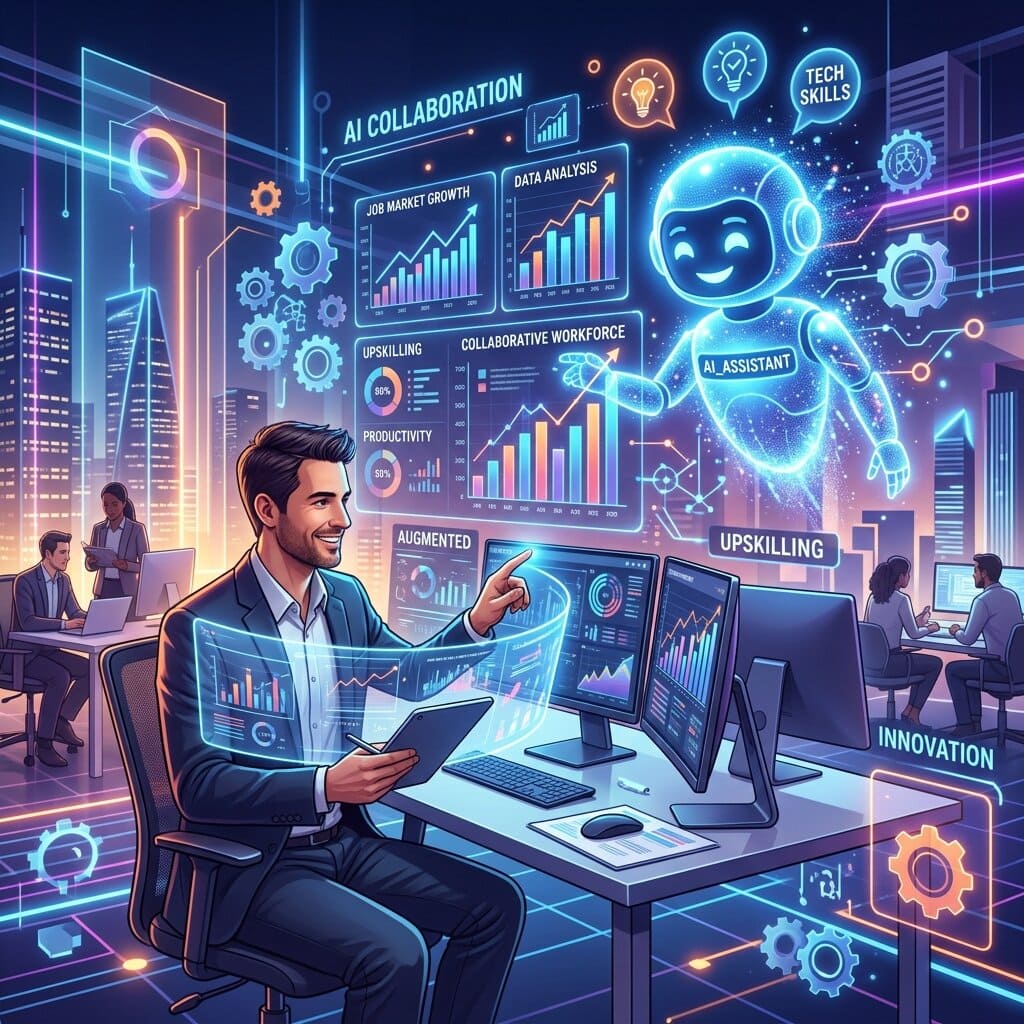
Artificial Intelligence (AI) is no longer a concept confined to science fiction movies or high-tech laboratories. Today, large language models, generative AI art tools, and automated system algorithms have woven themselves into our daily lives—from curating our social media feeds to drafting emails and organizing workflows.
But as AI becomes more capable, a pressing question arises: What does this mean for the future of work, and how can human professionals survive and thrive in an increasingly automated world?
Understanding AI's Disruption of the Job Market
Historically, technological revolutions (like the industrial or computing ages) primarily automated physical labor. The AI revolution is different. For the first time, automation is targeting cognitive labor—tasks involving writing, analyzing, coding, and organizing data.
Which Jobs Are Most at Risk?
Jobs that involve repetitive, rule-based digital tasks are facing immediate pressure from AI tools. Some of the most vulnerable sectors include:
1. Basic Data Entry and Administration
AI is incredibly efficient at parsing, sorting, and inputting numbers. Roles that rely purely on manual copying, scheduling, or basic database data entry are being automated rapidly.
2. Customer Support and Chat Operations
Advanced AI agents can handle thousands of customer queries simultaneously, resolving billing issues, tracking packages, and answering FAQs in seconds without getting tired.
3. Content Translation and Proofreading
Machine learning translation algorithms have reached near-human accuracy in milliseconds, heavily reducing the need for basic translation and proofreading work.
4. Basic Software Debugging and Coding
Generative models can write boilerplate code, write basic scripts, and find bugs in standard code blocks. Entry-level coding roles are shifting from writing raw code to reviewing and guiding AI outputs.
How to Stay Relevant in the Age of AI
While AI will displace certain roles, it is also a powerful tool that creates new opportunities. To protect your career and stay highly relevant, consider adopting these key strategies:
1. Focus on the "Human-Only" Skills (Soft Skills)
AI is excellent at logic, but it lacks empathy, emotional intelligence, negotiation capabilities, and true creative innovation. Careers that depend heavily on complex human relationships—such as leadership, coaching, mental health counseling, and high-level strategy—are highly insulated from automation.
2. Pivot from "Doing" to "Directing"
Instead of competing against AI, learn to manage it. A graphic designer who uses AI tools to generate 10 drafts in an hour is far more valuable than one who spends a day drawing one draft. Treat AI as a highly competent virtual intern. Your value lies in your judgment, direction, and curation of the AI's output.
3. Learn AI Literacy and Prompt Engineering
No matter your industry, learning how to use AI platforms (like ChatGPT, Claude, Midjourney, or specialized industry tools) is becoming as essential as knowing how to use Microsoft Office or Google Docs. Prompt engineering and workflow automation are highly sought-after modern skills.
4. Embrace Continuous Lifelong Learning
The era of having one set of career skills for life is over. The pace of change demands adaptability. Make it a habit to allocate an hour or two every week to learn about new digital tools, workflows, and industry changes.
The Bottom Line: Collaboration, Not Competition
AI is not necessarily going to take your job, but a professional who knows how to collaborate with AI might. By focusing on emotional intelligence, learning to guide automated systems, and constantly upgrading your skill set, you can turn the AI revolution into an accelerator for your career growth.