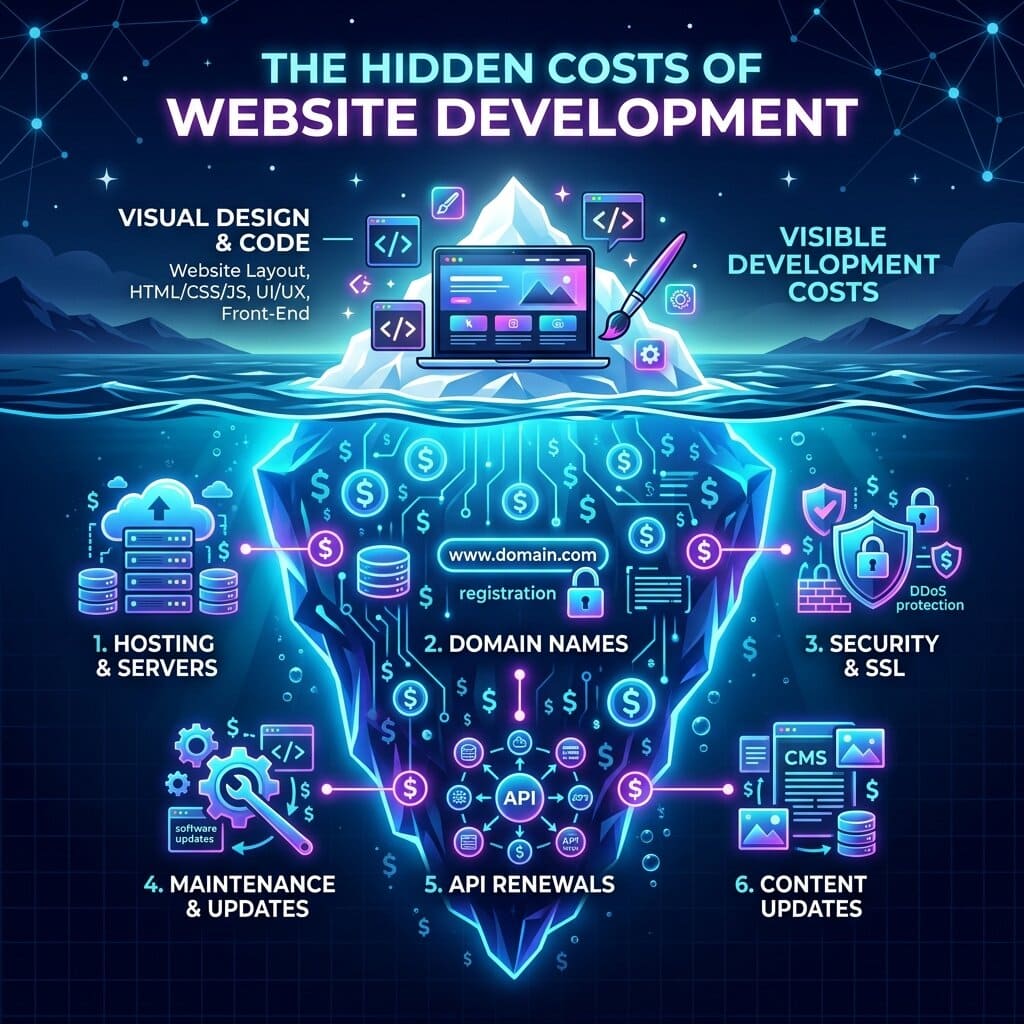
When planning a new website, most business owners focus almost entirely on the invoice for the initial design and coding. It is easy to assume that once the website is built and launched, the project is completed and the expenses stop.
In reality, a website is not a static piece of brochures; it is a dynamic digital engine. Like a physical office building, a website requires ongoing maintenance, security safeguards, utilities, and renewals to remain open, secure, and operational.
If you are budgeting for a new web development project, here are the essential "hidden" costs you must plan for after the initial launch.
1. Domain Registration and Renewals
Your domain name (e.g., yourcompany.com) is your digital address. While the first-year purchase might be cheap (often between $10 to $20), domain renewal prices can fluctuate. Additionally, premium domain extensions (.io, .tech, .ai) have higher annual renewal fees, sometimes ranging from $50 to over $100 per year.
2. Web Hosting
Hosting is the rent you pay to store your website's files, databases, and media on a web server.
- Shared Hosting ($5 - $15/month): Good for basic, low-traffic sites, but offers limited performance.
- Virtual Private Servers (VPS) / Cloud Hosting ($20 - $80/month): Essential for growing business websites.
- Dedicated/Enterprise Hosting ($150+/month): Required for high-traffic e-commerce systems and complex apps.
Choosing cheap hosting can lead to slow load speeds, downtime, and lost sales.
3. SSL Certificates and Security Protocols
An SSL certificate encrypts data sent between your visitor's browser and your server (enabling the 'HTTPS' lock icon). While basic SSL certificates are often provided free (via Let's Encrypt), enterprise-grade Wildcard or Extended Validation (EV) SSL certificates require annual renewal fees ranging from $50 to $300+. In addition, firewall protection and malware scanning services (like Sucuri or Cloudflare) add crucial layers of security that cost monthly.
4. Third-Party APIs and Premium Plugin Renewals
Modern websites rarely run on isolated code. They utilize third-party services for payments (Stripe, PayPal), maps (Google Maps API), email dispatchers (SendGrid, Mailchimp), or premium Content Management system extensions. Many of these plugins and APIs charge on a recurring subscription basis or usage-based pricing. If a crucial premium plugin subscription expires, your checkout forms or database integrations could break.
5. Content Updates and Maintenance Service Agreements
Search engines reward active websites. Keeping your website updated with new blog posts, service alterations, staff changes, and software patches (for PHP, databases, and plugins) takes time. Many businesses hire web agencies for monthly maintenance retainers (often starting from $100 to $500+/month) to guarantee their site remains secure, fast, and bug-free.
Summary: Plan Your Budget Wisely
The key to a successful digital presence is understanding that web development is an ongoing operational expense, not a one-time transaction. By budgeting for domain renewals, robust hosting, security safeguards, API subscriptions, and technical maintenance from day one, you ensure your website remains a high-performing business asset for years to come.