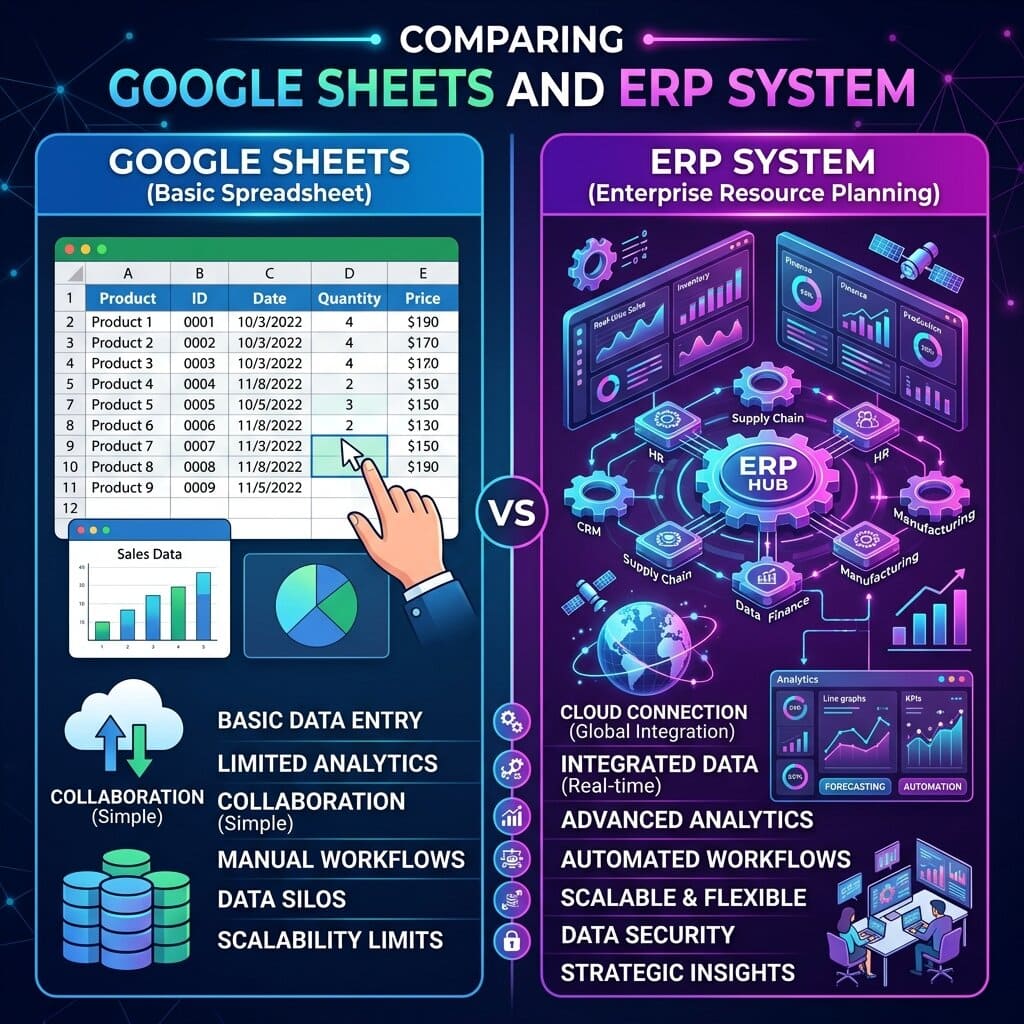
Google Sheets is the unsung hero of the startup world. When you are just launching a business, spreadsheets are the perfect solution: they are free, easy to use, highly flexible, and require zero training. Whether you are tracking inventory, managing customer leads, or monitoring your financial cash flow, Google Sheets gets the job done.
However, as a business begins to grow, the very flexibility that makes Google Sheets so appealing starts to become a major risk.
Here is a breakdown of why spreadsheets fall short as operations scale, and how to know when it is time to upgrade to a dedicated Custom Enterprise Resource Planning (ERP) system.
The Limitations of Spreadsheet-Based Operations
1. Lack of Structured Database Integrity
In Google Sheets, anyone can overwrite any cell. A user can accidentally type a text string into a formula cell, instantly breaking calculations across multiple sheets. ERP systems enforce database rules and user permissions, ensuring that financial ledger items, inventory numbers, and order states cannot be corrupted.
2. Zero Audit Trails
If an inventory count changes in Google Sheets, it is very difficult to trace who made the change, when they made it, and why. A custom ERP registers every single data modification as a logged system activity (complete with user details and timestamps), providing a robust audit log essential for security and compliance.
3. Limited Concurrency and Performance
When multiple departments (Sales, Warehouse, Finance, Management) all access the same sheet at once, performance slows down, sync conflicts occur, and loading times increase. An ERP handles thousands of concurrent data operations instantly using robust relational databases like MySQL or SQL Server.
4. Bounded Integrations
Google Sheets operates as an isolated island. Getting it to communicate in real-time with your shipping carrier, payment gateway, barcode scanners, or production factory equipment is highly complex and brittle. An ERP serves as a central hub, communicating natively with all external devices and third-party APIs.
When Should Your Business Upgrade to an ERP?
Ask yourself these four questions:
- Are employees spending hours manually copy-pasting data between different sheets to generate reports?
- Have you suffered financial or inventory errors due to outdated formulas or manual data entry mistakes?
- Is it becoming difficult to restrict sensitive client data or financial reports from certain employees?
- Are you struggling to get a single, unified view of your company's real-time performance metrics?
If you answered yes to any of these, your business has outgrown spreadsheets. Upgrading to a custom ERP streamlines operations, safeguards data integrity, and establishes the automation groundwork needed to scale your business to the next level.