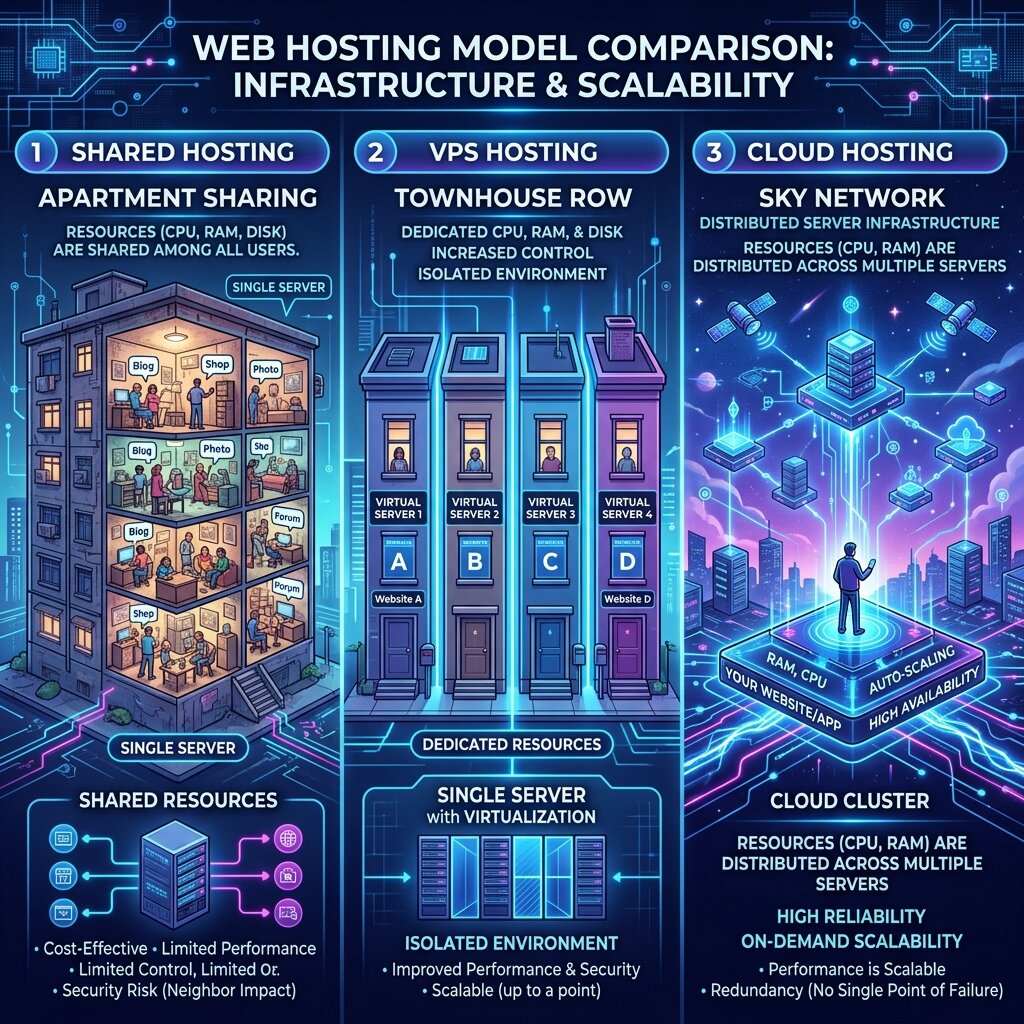
Choosing the right hosting infrastructure is one of the most critical decisions when deploying a new website or web application. The layout and architecture you choose directly impacts site speeds, user load limits, and security vulnerabilities.
Let's break down the three primary hosting frameworks:
1. Shared Hosting (The Apartment Complex):
Shared hosting places multiple websites on a single physical server, sharing CPU, RAM, and network bandwidth. It is highly cost-effective and easy to manage, making it perfect for small personal blogs or startup landing pages. However, because you share resources, a sudden traffic spike on another site can slow yours down (known as the 'noisy neighbor' effect).
2. VPS Hosting (The Townhouse):
Virtual Private Server (VPS) hosting uses virtualization software to split a single physical server into multiple isolated virtual environments. Each VPS has its own dedicated partition of resources (CPU, RAM). It provides much greater security, custom root configuration access, and stable performance. It is ideal for growing e-commerce platforms and business websites that need reliable uptimes without cloud complexity.
3. Cloud Hosting (The Sky Network):
Cloud hosting connects a network of virtual servers spread across multiple physical clusters. Your site is not tied to one machine; instead, resources are pooled dynamically. If one physical node fails, another immediately takes over without downtime. Cloud hosting supports instant auto-scaling to handle millions of requests, making it the industry standard for enterprise applications, SaaS systems, and heavy web traffic portals.
By mapping your scaling roadmap against these hosting tiers, you ensure your platform stays fast and secure at a budget that makes sense.